
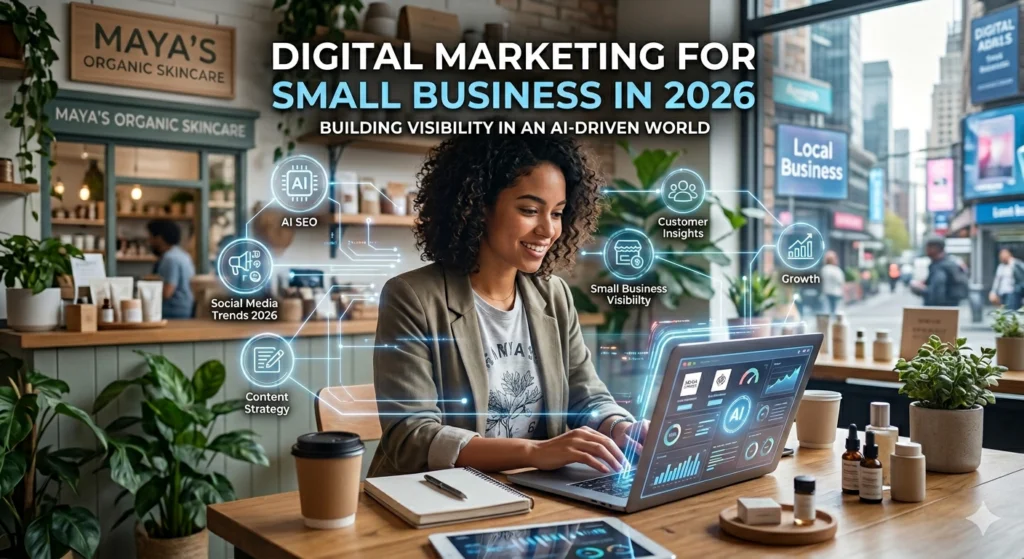
Most small businesses believe they have a marketing problem. They don’t. They have a discovery problem. That’s exactly why digital marketing for small business has become more important than ever. Think about it. A customer can only buy from you if they know you exist. And in 2026, customers are discovering businesses in more places than ever before. The reality is simple: if your business isn’t showing up where your customers are looking, you’re losing opportunities every day. Digital marketing helps bridge that gap by putting your brand in front of the right audience at the right time…
- ChatGPT
- Youtube
- Google Maps
- Voice Search
- Online Reviews
The challenge isn’t creating a great product anymore. The challenge is being visible wherever your customers are looking. That’s what this guide is about. Not marketing theory. Not buzzwords. A practical guide to digital marketing for small business that can help companies grow in 2026
The New Rule of Business Growth
Ten years ago, a good location could make a business successful.
Today, digital visibility is the new location.
This is one of the biggest reasons why digital marketing for small business has become a critical investment rather than an optional expense.
A shop hidden in a small lane can outperform a company on a prime road if it dominates online search.
That’s the reality.
Customers don’t walk around searching for businesses.
They search online.
The business they find first often gets the opportunity first.
Effective digital marketing for small business helps companies appear at the exact moment potential customers are looking for solutions.
This shift is exactly why digital marketing for small business is no longer optional. Businesses that invest in their online presence are far more likely to attract customers than those relying solely on traditional methods.
How customer discovery has changed
| How Businesses Were Found Before | How Customers Discover Businesses in 2026 |
|---|---|
| Foot traffic | Google Search |
| Newspaper ads | AI Search Tools |
| Word-of-mouth only | Online Reviews |
| Physical directories | Google Maps |
| Flyers and brochures | Social Media Platforms |
| Local referrals | Video Content and YouTube |
| Store location | Search Visibility |
This shift is exactly why digital marketing for small business has become essential. Businesses that adapt to modern customer behavior are more likely to attract qualified leads and grow consistently.
Why Most Small Businesses Struggle With Marketing
Many business owners make the same mistake.
They jump straight into tactics.
They start posting on social media.
They boost a few posts.
They run some ads.
Then they wonder why nothing changes.
The problem?
They skipped the foundation.
Many people assume digital marketing for small business is simply about being active online. It isn’t.
Marketing works best when built like a house.
Without a foundation, everything eventually collapses.
Many failed digital marketing for small business campaigns can be traced back to weak foundations rather than poor tactics.
The V.I.S.I.B.L.E Framework for Small Business Growth
The V.I.S.I.B.L.E Framework at a Glance
| Element | Purpose | Business Impact |
|---|---|---|
| Visibility | Get found online | More traffic |
| Information | Educate customers | More trust |
| Social Proof | Build credibility | Higher conversions |
| Intent | Attract buyers | Better leads |
| Brand Authority | Demonstrate expertise | Competitive advantage |
| Lead Capture | Convert visitors | More inquiries |
| Evaluation | Measure results | Smarter decisio |
Instead of looking at marketing channels separately, let’s focus on what actually matters.
I call this the V.I.S.I.B.L.E Framework.
V — Visibility
At its core, digital marketing for small business is about increasing visibility where potential customers are already searching for solutions.
Customers cannot buy what they cannot find.
Visibility means showing up when someone searches for solutions.
Ask yourself:
- Do you appear on Google Maps?
- Does your website rank for important searches?
- Do AI tools recognize your business?
If the answer is no, that’s your first priority.
I — Information
One of the most overlooked aspects of digital marketing for small business is educating potential customers before they make a purchasing decision.
People buy confidence before they buy products.
When customers visit your website, they look for answers.
Not advertisements.
They want to know:
- What do you offer?
- How does it help them?
- Why should they trust you?
The businesses that educate often outperform businesses that only sell.
S — Social Proof
Social proof remains one of the most important elements of digital marketing for small business because trust directly influences purchasing decisions.
Trust is the currency of online business.
Before contacting a company, customers often check:
- Reviews
- testimonials
- Case Studies
- Social Media Activity
A business with strong proof feels safer.
And safer businesses win more customers.
I — Intent
Successful digital marketing for small business strategies focus on answering customer questions before asking for a sale.
Not all traffic is valuable. A thousand random visitors are less valuable than ten serious buyers.
That’s why understanding customer intent matters.
Someone searching:
“How does SEO work?” is learning.
Someone searching:
“SEO agency for small business” is considering a purchase!
Focus your efforts where buying intent exists.
B — Brand Authority
Consistent content creation strengthens digital marketing for small business efforts by positioning a company as a trusted source of information
Authority influences decisions. People trust businesses that appear knowledgeable. One of the fastest ways to build authority is through content.
Useful blogs.
Helpful videos.
Detailed guides.
Industry insights.
The goal isn’t to impress Google.
The goal is to become the obvious choice.
L — Lead Capture
One of the primary goals of digital marketing for small business is converting visitors into leads and leads into customers.
Many businesses lose potential customers because they don’t capture leads effectively.
Imagine attracting hundreds of visitors every month.
Then giving them no reason to contact you.
That’s a costly mistake.
Every website should have clear opportunities to:
- Request a quote
- Schedule a call
- Download a resource
- Start a conversation
Attention without action creates no revenue.
E — Evaluation
Marketing without measurement is guessing.
Successful businesses monitor:
- Website Traffic
- Lead Volume
- Converstion Rates
- Cost per lead
- Constomer acquisition costs
What gets measured improves.
Simple.
The Biggest Opportunity in 2026: AI Search
Businesses investing in digital marketing for small business today have an opportunity to become trusted sources that AI tools can recommend in the future.
This is where things get interesting. Search behavior has fragmented dramatically over the last few years. They’re asking AI tools questions directly.
Questions like:
“How are successful local businesses attracting customers who are already looking for solutions?”
or
“Which marketing strategy should a startup use?”
AI systems provide recommendations instantly. That changes everything. Businesses that create clear, trustworthy, detailed content are more likely to appear in those recommendations. This creates an enormous advantage for businesses that start early.
What Separates Businesses That Get Found From Businesses That Get Forgotten
Many businesses spend too much time chasing platforms.
Platforms change.
Assets remain.
Focus on building these three assets.
Asset #1: Your Website
Your website is digital property you control.
Social platforms can change algorithms tomorrow.
Your website remains yours.
Invest in it.
Asset #2: Your Customer Database
Email subscribers.
Past customers.
Leads.
These contacts become more valuable over time.
The larger your database becomes, the less dependent you are on advertising.
Asset #3: Your Content Library
Content remains a cornerstone of digital marketing for small business because it can continue attracting visitors long after publication.
Quality content remains one of the strongest pillars of digital marketing for small business because it continues attracting visitors long after it is published.
Every blog post becomes an asset.
Every guide becomes an asset.
Every FAQ becomes an asset.
Years later, these assets can still generate leads. Very few marketing activities provide that kind of long-term value.
Hidden Obstacles That Make Customer Acquisition Harder
Many companies struggle with digital marketing for small business because they focus on tactics instead of building a long-term strategy.
Let’s save some time.
Avoid these common mistakes.
Stop Chasing Every New Platform
You don’t need to be everywhere.
You need to be where your customers are.
—-
Stop Buying Followers
Followers don’t pay invoices.
Customers do.
—-
Stop Publishing Content Without Purpose
Every piece of content should answer a customer question.
If it doesn’t, rethink it.
—-
Stop Ignoring Reviews
Reviews influence buying decisions more than most advertisements.
Actively request them.
Where to Focus First When Building an Online Presence
If you’re new to digital marketing for small business, focus on building strong foundations before investing heavily in advertising.
If I owned a small business today, here’s exactly where I’d start.
First 30 Days
- Improve website speed
- Update business information
- Optimize Google Business Profile
- Add clear contact forms
Days 31–60
- Publish helpful content
- Collect customer reviews
- Improve local search visibility
Days 61–90
- Launch targeted advertising
- Build an email list
- Track lead generation metrics
This approach creates momentum without overwhelming your team.—
What the Most Successful Small Businesses Understand
The most effective digital marketing for small business strategies are built around consistency rather than quick wins.
They don’t view marketing as an expense.
They view it as an asset.
Every blog.
Every review.
Every customer email.
Every ranking page.
Every piece of content.
These assets compound over time.
And compounding is where real growth happens.
Final Thoughts
The future of digital marketing for small business will belong to brands that create trust, provide useful information, and remain visible across search engines, AI platforms, and social channels.
Digital marketing for small business in 2026 is no longer about finding shortcuts.
It’s about becoming easier to discover, easier to trust, and easier to choose.
Businesses that focus on visibility, authority, trust, and customer experience will continue to grow.
Those that rely only on word-of-mouth will find it increasingly difficult to compete.
The goal isn’t to market harder.
The goal is to become impossible to ignore.
And that’s exactly what great digital marketing helps you achieve.
Digital marketing for small business refers to using online channels such as SEO, social media, content marketing, email marketing, and paid advertising to attract customers, generate leads, and increase sales.
FAQ’S:-
1. Why is digital marketing important for small businesses in 2026?
Digital marketing helps small businesses increase visibility, reach potential customers online, build trust, and compete with larger companies. In 2026, Digital marketing for small business is especially important beacuse consumers use search engines, AI tools, social media platforms, and online reviews to discover businesses before making purchasing decisions. A strong digital presence ensures your business can be found wherever potential customers are searching, helping generate more leads and sales over time.
2. Can digital marketing help a local business compete with larger companies?
Yes. Digital marketing for small business allows local businesses to target highly specific audiences, improve online visibility, and attract customers without needing the large budgets typically available to bigger brands. Strategies such as Local SEO, content marketing, Google Business Profile optimization, and social media marketing help smaller businesses compete effectively by focusing on relevance and customer experience rather than advertising spend alone.
3. What is the most effective digital marketing strategy for small businesses?
The most effective digital marketing for small business strategy combines Local SEO, content marketing, Google Business Profile optimization, social media marketing, email marketing, and targeted advertising. Rather than relying on a single channel, businesses should create a system that attracts visitors, builds trust, captures leads, and nurtures customer relationships. A balanced approach typically delivers better long-term results than focusing on one tactic alone.
4. How much should a small business spend on digital marketing?
Most small businesses invest between 5% and 10% of their annual revenue in marketing. However, the ideal budget for digital marketing for small business depends on factors such as business goals, competition, industry, and growth targets. New businesses often invest more aggressively to build visibility, while established companies focus on maintaining and optimizing their marketing efforts for consistent lead generation and customer retention.
5. Is SEO still worth it for small businesses in 2026?
Absolutely. SEO remains one of the most cost-effective ways to attract qualified traffic and generate leads. Unlike paid advertising, SEO can continue delivering results long after the initial investment. It also helps businesses appear in Google search results, Google AI Overviews, and AI-powered search tools, making it an essential component of long-term digital growth.
6. How can a small business get more leads online?
Small businesses can generate more leads by improving their website experience, optimizing for local search, publishing helpful content, collecting customer reviews, and running targeted advertising campaigns. Clear calls-to-action, fast-loading pages, and trust-building elements such as testimonials and case studies can significantly improve conversion rates and turn website visitors into paying customers.
7. What is Local SEO and why does it matter?
Local SEO helps businesses appear in location-based searches such as “near me” queries and Google Maps results. It is especially important for businesses serving specific cities or regions. By optimizing business listings, collecting reviews, and creating location-focused content, companies can increase visibility among nearby customers who are actively searching for products or services.
8. How does AI search affect digital marketing?
AI search tools such as ChatGPT, Gemini, and Perplexity provide direct recommendations and answers instead of simply displaying a list of websites. Businesses that create clear, trustworthy, well-structured, and informative content have a greater chance of being referenced by these platforms. As AI search continues to grow, businesses should focus on authority, expertise, and content quality to remain visible.
9. What are the biggest digital marketing mistakes small businesses make?
Common mistakes include ignoring Local SEO, failing to track performance metrics, publishing inconsistent content, relying on a single marketing channel, and not optimizing websites for conversions. Many businesses also focus on short-term tactics instead of building a long-term strategy. Avoiding these mistakes can help improve visibility, generate more qualified leads, and increase marketing effectiveness.
10. How long does digital marketing take to show results?
The timeline depends on the strategy being used. Paid advertising can generate traffic and leads within days, while SEO and content marketing often take several months to produce meaningful results. Businesses that consistently invest in digital marketing and focus on long-term growth usually achieve stronger and more sustainable outcomes than those looking for quick wins.